Arc Raiders Shows AI Development Actually Works
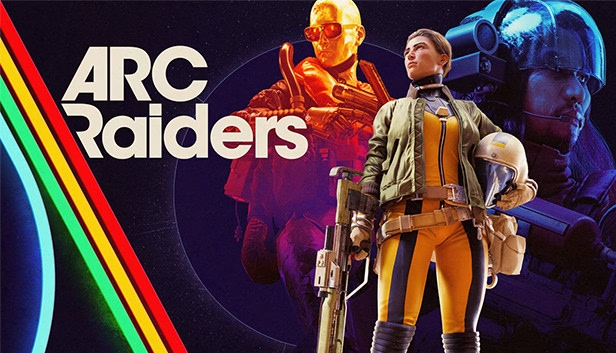
Something remarkable happened in gaming's ongoing budget crisis, and honestly, most people almost missed it. While studios across the industry continue wrestling with astronomical costs and crushing developer workloads, one company quietly demonstrated that artificial intelligence in game development isn't just theoretical anymore—it's shipping 14 million copies.
The Numbers Tell a Different Story
Nexon's Embark Studios achieved something that seemed impossible just a few years ago. They trained specialized AI systems using billions of actual player interactions, then used those insights to build Arc Raiders with considerably fewer people and significantly less money than traditional AAA development typically demands. The March 2026 Capital Markets Briefing wasn't just corporate talk—CEO Junghun Lee called it definitive proof that game development has fundamentally changed.
What makes this particularly interesting is how different it feels from the usual industry promises. This isn't vaporware or marketing spin. Players are actually experiencing the results right now, with consistent updates arriving faster than anyone expected and, perhaps most surprisingly, at a price point that doesn't require mortgaging your gaming budget.
Beyond the Automation Hype
The approach Nexon took goes deeper than simply automating repetitive tasks. Their proprietary AI training draws from massive datasets of player behavior—literally billions of interactions—to inform everything from asset creation to live service balancing. It's not replacing human creativity; it's amplifying what developers can accomplish with their available resources.
Traditional game development operates like a massive assembly line, requiring hundreds of hands touching every element. Embark's methodology shifts toward something more surgical and responsive. Instead of brute-forcing production with sheer labor volume, they're using data-driven insights to make smarter decisions faster. The development cycle now responds to player behavior in weeks rather than the typical months-long iteration process.
| Traditional Development | AI-Guided Approach |
|---|---|
| Large team required | Smaller, focused teams |
| Multi-month update cycles | Week-scale responsiveness |
| Fixed $70 price point | Flexible, accessible pricing |
| Script-based enemy AI | Reactive, adaptive behavior |
What Players Actually Notice
Theory sounds great in boardrooms, but does it translate to gameplay? The recent "Flashpoint" updates provide some answers. Enemy behavior in Arc Raiders genuinely feels different—less like following predetermined patterns and more like actual adaptation. When you approach encounters, the ARC forces respond to your tactics rather than cycling through scripted sequences.
This reactive quality stems directly from AI-guided design systems analyzing how millions of players actually engage with the game. It's not perfect, but it's noticeably more dynamic than what you typically encounter in similar titles. The polish level matches games that cost substantially more to produce, which honestly raises questions about why the rest of the industry hasn't caught on yet.
The Price Point Nobody Expected
Here's where things get really interesting for anyone watching their wallet. While most AAA releases remain firmly planted at the $70 price ceiling, Arc Raiders stays considerably more accessible. The mathematics are straightforward—when development tools become more efficient, studios don't need to pass massive overhead costs directly to consumers.
This pricing strategy isn't charity or a temporary promotion. It reflects actual production economics changing in real-time. Smarter development tools and AI-assisted workflows create genuine cost savings that can flow through to retail pricing. For players, this means quality gameplay without the premium retail price tag that's become standard industry practice.
🎮 What This Means Going Forward
The "AI experiment" label no longer applies. Arc Raiders proves the concept works at scale with real players spending real time in the game world. For anyone paying attention to industry trends, this represents a massive shift in what's possible:
-
Higher update frequency: Changes arrive faster because iteration cycles compress dramatically
-
Better resource allocation: Developers focus on creative decisions rather than production grunt work
-
Sustainable development pace: Teams avoid the burnout that's plagued AAA studios recently
-
Accessible entry points: Lower production costs enable more flexible pricing strategies
Efficiency has genuinely become gaming's new competitive advantage. Studios that figure out AI-assisted development first will likely dominate the next decade, while those clinging to traditional methods face increasing pressure from ballooning budgets and longer development timelines.
The Wasteland Awaits (At a Better Price) 🌟
For anyone interested in jumping into Arc Raiders without paying premium retail prices, the timing actually matters. The game's pricing demonstrates that AI-guided development creates real economic advantages for consumers, not just publishers. The quality remains high while accessibility improves—a rare combination in modern gaming.
This isn't about predicting the future anymore. The transformation is happening right now, with 14 million players already experiencing what optimized game development actually delivers. Whether other studios follow Nexon's lead remains to be seen, but the proof of concept is no longer theoretical. It's live, it's playable, and it's showing the industry what's actually possible when AI enhancement meets human creativity.
The question isn't whether AI belongs in game development—Arc Raiders already answered that. The real question is how quickly the rest of the industry catches up. 🚀
