How I Watched a Deckbuilder Crush AAA Giants on Steam
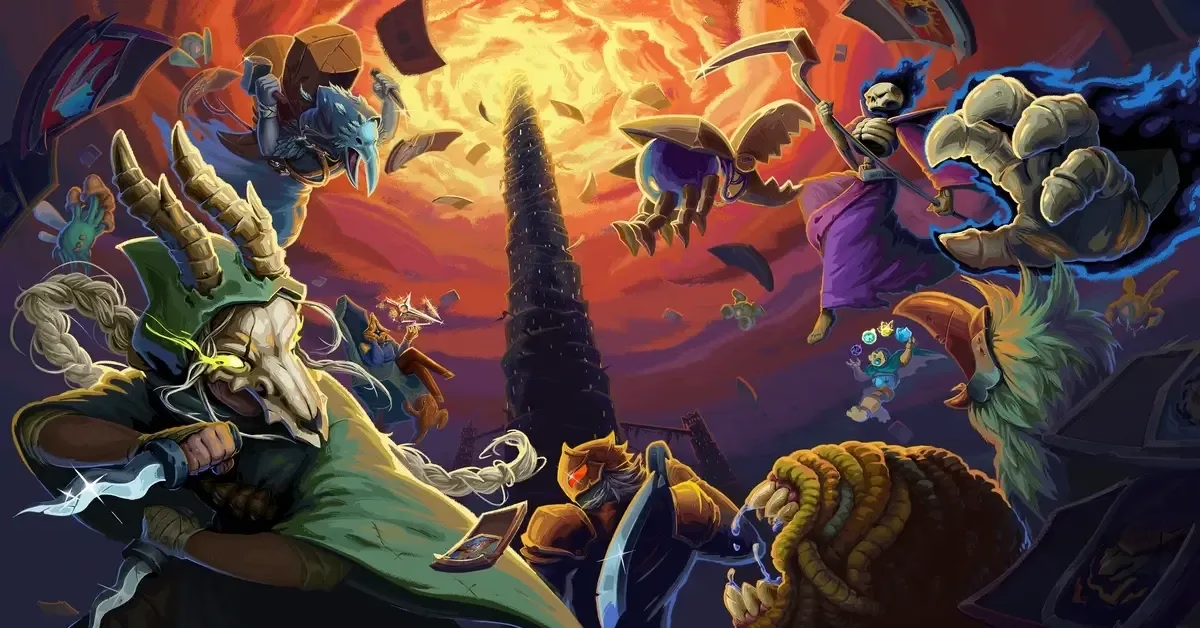
I never thought I'd see the day when a card-based roguelike would dethrone the biggest budget releases of the season, but here we are. March 2026 has been a wild month for gaming, and I've been glued to my screen watching Slay the Spire 2 absolutely dominate the Steam charts. While everyone else was hyping up the photorealistic landscapes of Crimson Desert and the spine-chilling promises of Resident Evil Requiem, I found myself drawn back to something far more intimate: strategic card battles in a mysterious spire.
The Unexpected Victory That Changed Everything
When I first heard that Slay the Spire 2 had become the best-selling game on Steam last month, I'll admit I was shocked. This wasn't some massive open-world adventure with celebrity voice actors or a horror sequel backed by decades of franchise history. This was a deckbuilding roguelike, a genre that many industry analysts had written off as "niche." Yet here it was, proving that gameplay depth and community trust can still triumph over marketing budgets in the hundreds of millions.
The data from Alinea Analytics confirmed what I'd been seeing in my own friend circles: players were flocking to the Spire in unprecedented numbers. Every Discord server I'm part of has been buzzing with talk of optimal deck compositions, boss strategies, and the endless "just one more run" addiction that only the best roguelikes can inspire. 🎮
Why I Believe This Success Story Matters
I've been gaming for over two decades, and I've watched the industry shift toward ever-larger production values. Don't get me wrong – I love a good cinematic experience as much as the next person. But there's something incredibly refreshing about seeing a game succeed purely on the strength of its mechanics and design philosophy.
Mega Crit didn't try to reinvent the wheel. They took what made the original Slay the Spire a masterpiece and refined it. The move to the Godot engine wasn't just a technical upgrade; it fundamentally changed how the game feels to play. The card interactions are smoother, the animations more responsive, and the overall experience feels polished in ways the original couldn't achieve with its older framework.
The Technical Revolution I Didn't Know I Needed
Let me break down what this engine change actually means for someone like me who plays the game:
-
Faster load times between floors and combat encounters
-
More complex card interactions that weren't possible in the original
-
Smoother animations that make every decision feel impactful
-
Better optimization across different hardware configurations
-
Enhanced visual effects without sacrificing the game's distinctive art style
I'm running the game on a mid-range PC, and the difference is night and day. The original occasionally stuttered during particle-heavy moments, but Slay the Spire 2 runs like butter even when I'm juggling dozens of card effects simultaneously.
The Necrobinder: My New Obsession
If there's one feature that's kept me coming back night after night, it's the Necrobinder. This new character class has completely changed how I approach each run. Where the original game's characters each had their own distinct playstyles, the Necrobinder brings something genuinely fresh to the table: a morbid, death-focused tactical layer that rewards careful planning and risk management.
I spent my first dozen runs with the Necrobinder just trying to understand the synergies. The class revolves around manipulating death and decay, turning fallen enemies into resources and building increasingly powerful combinations. It's not just about dealing damage – it's about controlling the battlefield in ways that feel genuinely unique. 💀
My Favorite Necrobinder Strategies
After about fifty hours with the character, I've developed a few approaches that consistently get me deep into the Spire:
-
The Sacrifice Build: Focus on cards that gain power from losing health or discarding cards
-
The Resurrection Combo: Stack effects that bring back defeated minions or replay exhausted cards
-
The Corruption Run: Embrace status effects and turn them into advantages
-
The Summoner Strategy: Build an army of temporary allies to overwhelm enemies
Each approach feels viable, and I'm constantly discovering new interactions that make me rethink my entire strategy. That's the mark of excellent game design.
The Price Point Question
At €22.99, I initially hesitated. Early Access games can be risky investments, and I've been burned before by titles that promised the world and delivered a buggy mess. But Slay the Spire 2 is different. Even in its current state, I've already put in over eighty hours, and I'm nowhere near exhausting the content.
The replayability factor is insane. Every run feels different thanks to:
-
Procedurally generated encounters
-
Hundreds of cards with unique interactions
-
Multiple character classes with distinct playstyles
-
Branching paths and decision points
-
Daily challenges and community-created modes
-
Constantly evolving meta-strategies
When I calculate the cost per hour of entertainment, Slay the Spire 2 has already become one of my most economical purchases this year. And with Mega Crit's track record of supporting their games long-term, I'm confident the value proposition will only improve.
The Early Access Advantage
Joining Early Access now means I get to watch the game evolve. Mega Crit has been incredibly transparent about their development roadmap, and the community feedback loop is fascinating to observe. I've already seen several balance patches that directly addressed concerns raised by the player base, and the developers are actively engaging with suggestions on forums and social media.
There's also a practical consideration: the price will likely increase when version 1.0 launches. Getting in now not only saves money but also gives me months or possibly years to master the game before the competitive meta fully crystallizes. For someone like me who loves being part of a game's growth journey, that's an invaluable experience. 📈
What This Means for the Industry
I've been following gaming industry trends closely, and Slay the Spire 2's success sends a powerful message. Players aren't just passive consumers waiting for the next big marketing campaign to tell them what to play. We're looking for games that respect our intelligence, reward mastery, and offer genuine depth.
The roguelike community has been growing steadily for years, but even I didn't expect a deckbuilder to outsell some of the year's most anticipated AAA releases. This success validates a design philosophy that prioritizes:
-
Mechanical depth over visual spectacle
-
Replayability over cinematic one-time experiences
-
Community engagement over massive marketing budgets
-
Iterative improvement over rushed launches
-
Fair pricing over aggressive monetization
My Personal Journey with the Spire
I discovered the original Slay the Spire back in 2019, and it quickly became one of my most-played games. I loved how it combined the strategic depth of deck-building card games with the unpredictability of roguelike dungeon crawling. Every run taught me something new, and the satisfaction of finally defeating the heart after dozens of attempts remains one of my favorite gaming memories.
When Slay the Spire 2 was announced, I had mixed feelings. The original was already so polished – could a sequel really improve on near-perfection? Now, after spending countless hours with the new game, I can confidently say that Mega Crit has achieved something remarkable. They've honored what made the original special while adding enough new content and mechanical refinements to justify the sequel.
The Community That Makes It Special
One aspect I can't overlook is the incredible community surrounding these games. The Slay the Spire subreddit, Discord servers, and streaming communities are filled with passionate players sharing strategies, celebrating victories, and commiserating over brutal defeats. I've learned so much from watching skilled players approach the game differently than I do, and the collaborative spirit of discovery is something special. 🤝
Looking Ahead
As I write this in 2026, Slay the Spire 2 is still in Early Access, which means the best is yet to come. Mega Crit has hinted at additional character classes, new card types, and expanded endgame content. If the development trajectory matches that of the original game, we're looking at years of support and content updates.
For anyone on the fence about purchasing, I can only speak from my own experience: this game has already provided me with more enjoyment than most full-priced AAA releases I've bought in recent years. The strategic depth is genuine, the replayability is essentially infinite, and the satisfaction of mastering its systems is deeply rewarding.
Final Thoughts
The triumph of Slay the Spire 2 over big-budget competitors isn't just a feel-good story for indie game enthusiasts – it's a reminder that the gaming industry's future doesn't belong exclusively to massive studios with unlimited resources. Sometimes, a small team with a clear vision and respect for their community can create something more impactful than any amount of marketing hype could achieve.
I'll be climbing the Spire for months to come, discovering new synergies, perfecting my strategies, and enjoying every minute of it. If you loved the original or you're curious about what makes roguelike deckbuilders so addictive, there's never been a better time to enter the Spire. Trust me – just one more run always leads to another. 🎴
