Marathon's Duos Experiment: A New Dawn for Paired Runners
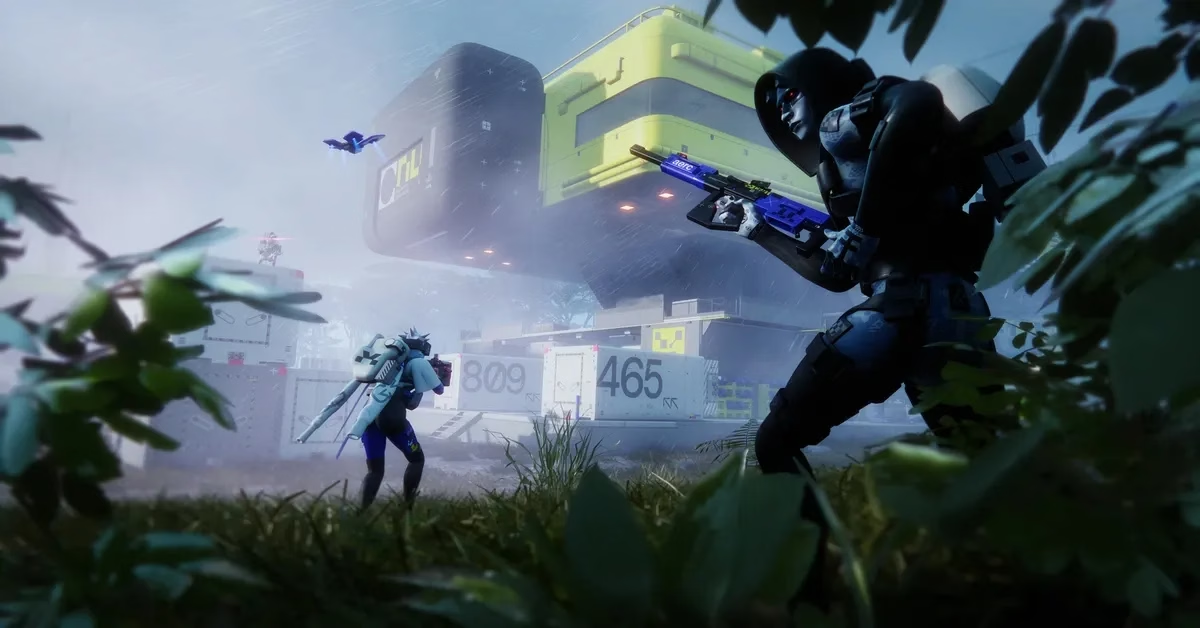
The winds of change sweep through Marathon's digital corridors, carrying whispers of transformation. Where once the relentless drumbeat of three-person fireteams echoed across every battlefield, a new rhythm begins to emerge—quieter, more intimate, yet no less fierce. Bungie, the architect of this unforgiving extraction realm, has finally acknowledged what solo wanderers and paired warriors have known all along: the magic number isn't always three.
The Perimeter Becomes a Laboratory of Possibility
Perimeter, that familiar battleground etched into the consciousness of every Runner, now stands transformed. No longer merely a proving ground for established trios, it has become something altogether different—an experimental canvas where the rules themselves bend and reshape. Beginning March 18, 2026, this zone opens its gates to a new kind of combat choreography, one designed specifically for crews of two. Game director Joe Ziegler's announcement rippled through the community like a stone cast into still water, its circles expanding outward with each passing moment.
The decision arrives not as a polished proclamation from on high, but as an admission—almost a confession—that the extraction formula needs refinement. Since Marathon first unveiled itself to the world, players have navigated a landscape dominated by numerical supremacy. Three against three, always three. Solo operators found themselves perpetually outmatched, while paired teams discovered their bonds tested against mathematically superior opposition. The community's voice, initially a murmur, crescendoed into something impossible to ignore.
Going Rogue: Bungie's Transparent Test Phase
What makes this initiative particularly fascinating is its raw, unvarnished nature. Bungie isn't presenting a finished product wrapped in marketing speak and glossy trailers. Instead, they're "going a bit rogue," as Ziegler frankly admitted on X. This is science in its purest form—hypothesis, experimentation, observation. Some elements, the director warns, "will be a bit jank." The user experience flow isn't ideal. Players must manually select "Perimeter – Duo" from the zone selection screen, a workaround rather than an elegant solution.
Yet this honesty feels refreshing, like cold water after a long firefight. The gaming landscape has grown weary of perfectly packaged disappointments and overpromised features that arrive DOA. Here, Bungie offers something different: participation in the creative process itself. They're essentially saying, "Look, this is rough around the edges, but we need your help figuring this out." It's vulnerable. It's real. It's kinda cool, actually.
The technical constraints are explicit. There's no matchmaking safety net catching solo players who wander in unprepared. You arrive with your partner or you don't arrive at all. The system will pair you exclusively against other duos—no mixed lobbies, no trio teams slumming it for easy pickings. This isolation ensures data integrity, allowing Bungie to examine how combat dynamics shift when each engagement involves precisely four players instead of six.
The Strategic Mathematics of Smaller Squads
Tactical Implications
Reducing squad size from three to two fundamentally alters the combat calculus:
| Aspect | Trios | Duos |
|---|---|---|
| Firepower Distribution | Three weapons platforms | Two weapons platforms |
| Flanking Capacity | Multiple simultaneous angles | Linear or split approach |
| Revive Dynamics | Two potential rescuers | Single point of failure |
| Communication Overhead | Complex coordination | Streamlined decision-making |
| Risk Assessment | Shared burden | Heightened consequence |
Every engagement becomes a higher-stakes proposition. The margin for error narrows. Positioning matters more when you lack that third angle of attack. Revives transform from tactical considerations into desperate gambles—there's no tertiary guardian watching your six while you perform battlefield triage. Yet this compression of possibility creates its own kind of beauty, a crystalline clarity where every decision carries weight.
The Empty Map Question ⚠️
Bungie's primary concern centers on spatial density. Perimeter was designed with twelve simultaneous players in mind—four trios circling, predator and prey in constant rotation. Dropping to eight players (four duos) risks creating dead zones, stretches of emptiness where the tension dissipates and the map breathes too freely. Will the extraction loop maintain its suffocating pressure with one-third fewer heartbeats echoing through its chambers?
This is why the test phase matters. Telemetry will reveal whether engagements cluster appropriately, whether sightlines remain contested, whether the psychological pressure that defines Marathon's identity persists or evaporates. If Perimeter's architecture proves compatible with this reduced player count, expansion to other zones becomes not just possible but probable.
Community Resonance and the Newcomer Gateway
The response from Marathon's community has been one of cautious optimism tinged with genuine excitement. Veterans who've longed to run with a single trusted companion rather than recruiting a third see validation. Newcomers intimidated by the established trio meta glimpse an entry point that doesn't require assembling a full fireteam before even understanding the game's rhythms.
What This Opens Up:
-
🎮 Lower Barrier to Entry: Convincing one friend is exponentially easier than coordinating two
-
💬 Simplified Communication: Duo dynamics naturally foster deeper coordination
-
🔄 Flexible Learning Curve: Partners can guide each other without the complexity of three-way strategizing
-
🎯 Enhanced Accountability: Individual contribution feels more meaningful
For those who've circled Marathon from a distance, watching streams and reading patch notes but never pulling the trigger, this experimental window represents something precious: permission to engage on more manageable terms. The "trios-only sweat-fest," as it's been characterized, transforms into something more accessible without sacrificing the core identity that makes Marathon distinct.
The Scientific Method Applied to Game Design
Ziegler's concluding rallying cry—"FOR SCIENCE!!"—isn't merely playful marketing speak. It's an accurate description of the methodology at play. Bungie is treating their live playerbase as collaborators in the design process, gathering empirical evidence to answer questions that can't be resolved through internal testing alone.
The variables under observation include:
-
Engagement Frequency: How often do duo teams encounter opposition?
-
Combat Duration: Do firefights resolve faster or develop into prolonged standoffs?
-
Extraction Success Rates: Does the reduced squad size impact mission completion?
-
Player Retention: Do participants return for subsequent runs?
-
Satisfaction Metrics: How do players rate the experience compared to standard trios?
This data collection phase will determine whether duos remain a Perimeter-exclusive curiosity or expand across Marathon's entire geography. The community holds genuine power here—not through surveys or forum posts, but through their actual behavior. Playing the mode, returning repeatedly, and demonstrating sustained engagement will speak louder than any petition.
The Path Forward Remains Unwritten
What makes this moment in Marathon's evolution compelling is its genuine uncertainty. Bungie hasn't predetermined the outcome. They're not testing a feature they've already decided to implement; they're genuinely asking whether this direction serves the game's long-term health. The experimental label isn't corporate hedging—it's literal truth.
If the Perimeter test reveals that duos dilute what makes Marathon special, the mode might vanish as quickly as it appeared. If telemetry shows combat flowing smoothly, tension maintaining its edge, and players embracing the format, we could witness a fundamental restructuring of how Marathon approaches squad composition. Perhaps zones will offer both trio and duo queues. Perhaps certain maps will become dedicated to specific squad sizes, each optimized for its particular player count.
The evolution feels organic, responsive rather than dictated. After months of community feedback bouncing off seemingly impenetrable walls, Bungie has opened a door. Not with fanfare or certainty, but with an invitation: Come test this with us. Help us understand what Marathon can become.
Seizing the Experimental Window 🚀
For players who've been waiting for the right moment to dive into Marathon's ruthless extraction loops, that moment has arrived. Grab your most trusted companion—the friend who covers your flanks, who reads your movements without words, who shares your appetite for high-stakes gambles. Boot up on March 18th, select Perimeter's duo option, and step into something that might just reshape the game's future.
The telemetry gathering isn't some abstract corporate exercise. It's built from your firefights, your victories, your failures. Every engagement you participate in contributes to the dataset that will determine whether duos expand or contract back into development limbo. In this rare instance, playing isn't just playing—it's actually participating in the creative process itself.
Marathon stands at a crossroads, and for once, the boots on the ground are helping draw the map. The extraction shooter that launched with rigid trio requirements now experiments with flexibility, listening to its community rather than dictating to it. Whether this experiment succeeds or fails, the attempt itself signals something valuable: a willingness to evolve, to adapt, to acknowledge that even carefully designed systems might need fundamental revision.
The Perimeter awaits, transformed into something new. Two runners, countless possibilities, and the weight of Marathon's future resting on whether this leaner formula captures the same desperate magic that made the original format compelling. Science demands observation, and this laboratory stands open, waiting for its data to arrive one firefight at a time. 🌙
