Monster Hunter Wilds Finally Tames Its PC Performance Demons
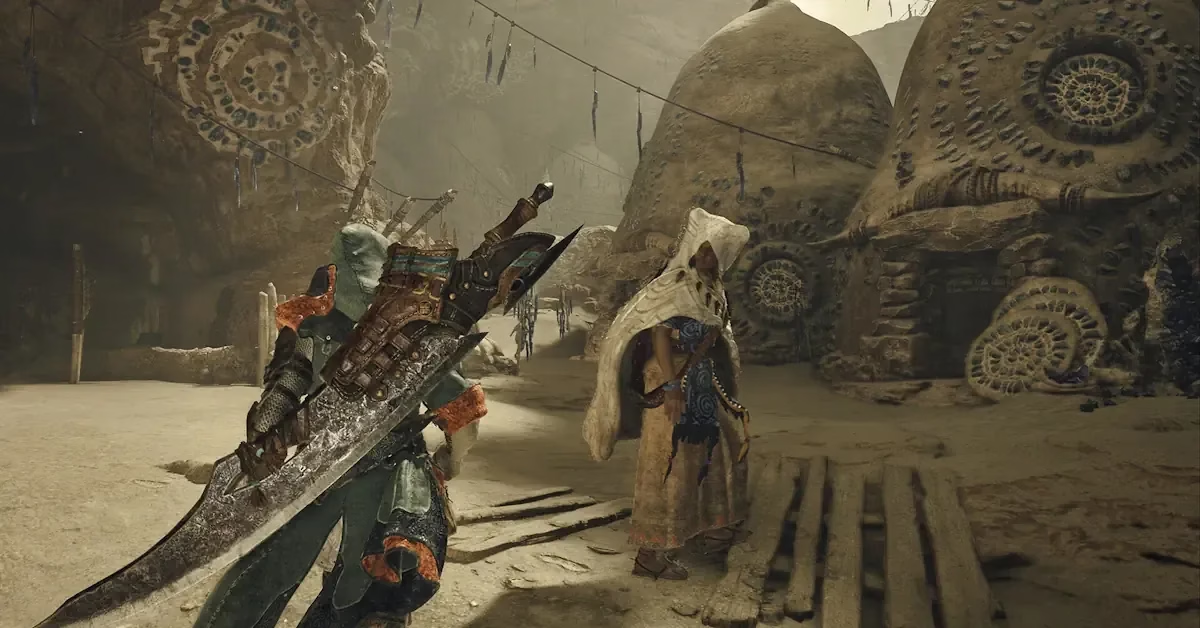
The waiting game is over, folks. After watching the Monster Hunter Wilds PC community wrestle with optimization woes for nearly a year, Capcom has unleashed what might just be the most transformative patch the game has ever seen. This isn't your garden-variety hotfix—this is a full-blown performance overhaul that fundamentally reimagines how the game breathes life into its sprawling, beast-filled ecosystems. If you've been sitting on the sidelines, controller in hand but patience wearing thin, January 28, 2026 marks the day you can finally join the hunt without your rig throwing a tantrum.
🎮 The Nightmare That Was Launch Day Performance
Picture this: You're deep in the zone, tracking a colossal wyvern through misty valleys, your Great Sword charged and ready for that devastating strike. The beast rears back, vulnerable—and then your screen hiccups. Frames drop like stones, textures pop in and out like cheap magic tricks, and suddenly you're questioning whether your $2,000 gaming PC was actually assembled from spare toaster parts. That's been the Monster Hunter Wilds experience for too many hunters since launch, and honestly? It stung.
The ambition behind Wilds was undeniable. Capcom wanted seamless transitions between biomes, massive creature AI that felt genuinely reactive, and environmental detail that would make your eyeballs dance. But ambition without optimization is just a pretty slideshow, and that's exactly what many players got. CPU usage would spike randomly, VRAM would max out even on beefy cards, and the whole experience felt like trying to sprint through quicksand while wearing full plate armor.
🔧 What Actually Changed Under the Hood
This isn't Capcom slapping a Band-Aid on a bullet wound and calling it a day. The January 2026 patch represents a fundamental restructuring of how Monster Hunter Wilds processes its visual and computational workload. At the heart of the transformation lies a complete rework of shader compilation—the technical wizardry that tells your GPU how to render light, shadows, and textures in real-time.
Previously, the game would compile shaders on the fly, which sounds efficient until you realize it's like trying to bake a cake while simultaneously writing the recipe. The result was those infamous micro-stutters that turned epic hunts into slideshows. Now, shader compilation has been pre-processed and optimized, meaning your GPU can actually focus on, you know, rendering the game instead of constantly recompiling instructions.
The CPU Relief Package
| Old System | New System | Impact |
|---|---|---|
| Constant DLC ownership checks | One-time verification at launch | Eliminated background CPU drain |
| Limited fog quality options (2 levels) | Granular fog control (5 levels: Lowest to Highest) | Better performance customization |
| No processor management tools | New dedicated CPU tab in settings | Direct load control for multi-core systems |
But wait, there's more. Remember that absolutely bonkers bug that had the game constantly pinging your DLC ownership status while chilling at Base Camp or the Grand Hub? Yeah, that digital nosiness was eating up processing power like a starving Deviljho at an all-you-can-eat buffet. Every cosmetic pack, every weapon skin you didn't own was being checked and rechecked in an endless loop. The patch murders this bug dead, meaning your downtime between quests should finally feel like actual downtime instead of watching your CPU fan spin up like it's preparing for liftoff.
📦 The Great Texture Pack Transformation
Now let's talk downloads, because this is where things get interesting. The standard game update? A modest 2.0 GB—barely a blip on modern SSDs. But if you've been rocking the High Resolution Texture Pack (and let's be real, who installs Monster Hunter without wanting it to look gorgeous?), you're looking at a 31 GB re-download.
Before you start sweating about your bandwidth cap, hear me out: this is actually fantastic news. See, Capcom didn't just patch the texture pack—they rebuilt it from the ground up with compression algorithms that would make mathematicians weep with joy. The kicker? After installation, you'll actually save 45 GB of storage space compared to the old version. That's right—you download 31 GB to reclaim 45 GB. It's like digital alchemy, and your poor SSD will thank you for the breathing room.
🎯 Fine-Tuning Your Hunt: The New Settings
Capcom has handed hunters the keys to the kingdom with genuinely useful customization options. The newly introduced CPU tab in the options menu isn't just cosmetic fluff—it provides actual, meaningful control over how the game distributes its workload across your processor cores. Mid-range CPU struggling with background processes? You can now tell Wilds to ease up without nuking your visual fidelity.
The volumetric fog expansion deserves special mention. Previously, you had two choices: fog on or fog off. Great. Real nuanced. Now you've got five distinct levels spanning Lowest to Highest, which means you can finally have atmospheric mist rolling through ancient forests without sacrificing 20 frames per second. This kind of granularity is what separates a rushed port from a game that actually respects the diversity of PC hardware configurations.
Settings Breakdown for Different Hardware Tiers
Budget Builds (GTX 1660 / RX 5600 XT tier):
-
Volumetric Fog: Lowest or Low
-
CPU Management: Enable all conservation options
-
Texture Quality: Medium (Standard pack recommended)
Mid-Range Warriors (RTX 3060 / RX 6700 XT tier):
-
Volumetric Fog: Medium to High
-
CPU Management: Balanced profile
-
Texture Quality: High (High-Res pack viable)
High-End Enthusiasts (RTX 4080+ / RX 7900 XT+ tier):
-
Volumetric Fog: Highest
-
CPU Management: Performance mode
-
Texture Quality: Ultra (High-Res pack essential)
⚠️ The Driver Situation: Don't Skip This Step
Before you slam that update button and rush back into the fray, do yourself a massive favor and update your GPU drivers. I know, I know—driver updates are about as exciting as watching paint dry on a rainy Tuesday. But trust me on this one. Capcom has specifically called out driver requirements, and they're not just throwing version numbers around for fun.
NVIDIA users: You need version 581.57 or newer. Anything older and you're risking crashes, graphical glitches, and the kind of visual artifacts that make you question if your GPU is having an existential crisis.
AMD users: Version 25.9.1 or 25.9.2 are your targets. AMD's driver team has been coordinating directly with Capcom on this patch, so these versions contain game-specific optimizations you absolutely want.
Seriously, bookmark this. Pin it to your desktop. Tattoo it on your gaming mousepad. Whatever it takes to remember to update before launching. The patch can only do so much if your driver is still living in 2025.
💭 What This Means for the Future
Here's the thing that really matters: Capcom didn't take the easy route. They could've just slapped some lower-quality textures in, reduced draw distances, and called it "optimization." Instead, they rebuilt core systems, rewrote shader pipelines, and gave us actual tools to manage performance ourselves. That's not just fixing a problem—that's respecting the platform and its players. 😤
The longevity implications are huge. With these foundations now stable, future content drops—new monsters, biomes, weapons—can build on solid ground instead of a performance house of cards. Plus, it signals that Capcom is committed to Monster Hunter Wilds as a long-term platform rather than a fire-and-forget release. In an era where many publishers treat PC as an afterthought, this kind of dedicated engineering actually matters.
🎪 The Verdict: Is It Time to Return?
If you've been on the fence, lurking in Discord servers reading performance threads, this is your engraved invitation back to the hunt. The game that launched with so much promise but stumbled on technical execution has finally grown into its own ambitions. Frame rates are stable, VRAM usage is reasonable, and that soul-crushing DLC check bug has been sent to the digital graveyard where it belongs.
For those who never left—who powered through the stutters and hitches out of sheer love for the franchise—your patience has been rewarded. The game now plays like it was always supposed to, and honestly? It's glorious. The seamless transitions between biomes finally feel seamless. The massive monster encounters maintain their cinematic impact without sacrificing fluidity. Base Camp loading times are genuinely fast instead of "grab a sandwich" territory.
🚀 Looking Ahead
The broader gaming community should take notes here. This is how you support a live-service adjacent title properly. Not with empty promises or vague "we're looking into it" statements, but with substantial, measurable improvements that directly address player pain points. Capcom has set a benchmark, and frankly, other publishers should feel a bit embarrassed if they're not matching this level of commitment.
So what's the move? Are you booting up tonight, eager to see how your rig handles the new optimizations? Or are you the cautious type, waiting for Digital Foundry's frame-time graphs and Reddit's collective verdict? Either approach is valid, but here's my two cents: the wait is over. The hunt calls, and for the first time since launch, your PC is actually ready to answer. 🎯
The monsters of the New World aren't going to hunt themselves, and now you can finally face them without your PC throwing a technical tantrum every five minutes. That Great Sword isn't going to swing itself, hunter. Time to get back out there.
