Resident Evil Requiem: A Shadow-Dropped Bargain in Survival Horror
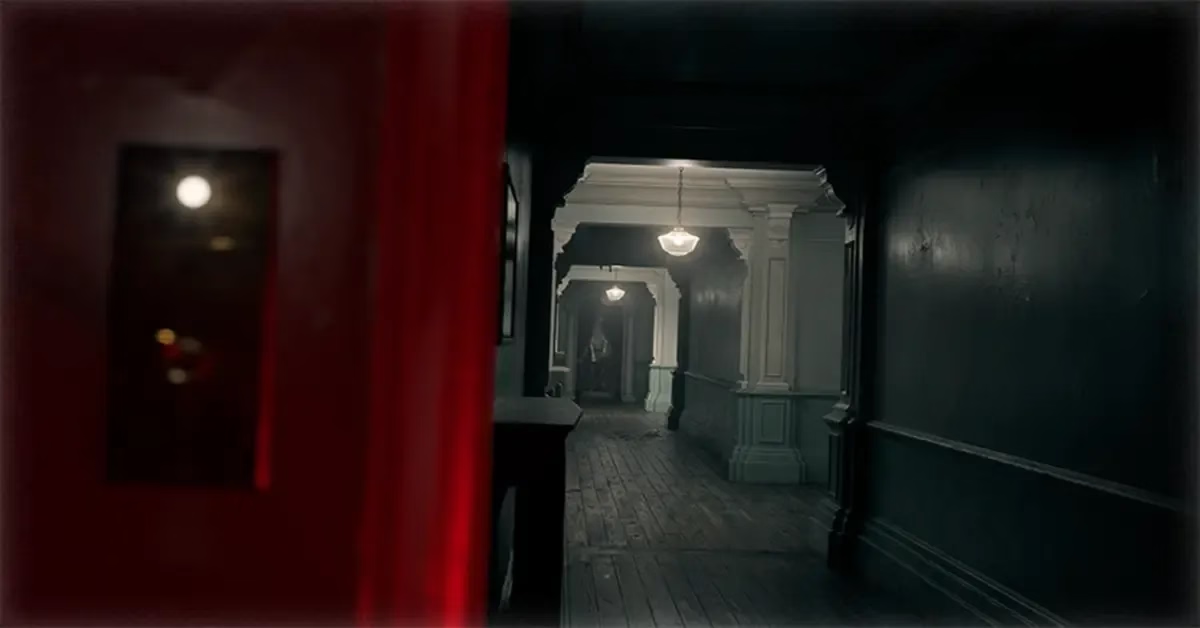
Beneath the flickering neon of 2026's gaming landscape, a phantom emerged from Capcom's vault without fanfare or trumpet—Resident Evil Requiem arrived like a specter in the night, its dual narratives weaving through abandoned corridors and fractured psyches. The game whispers its tales through two souls: FBI analyst Grace Ashcroft, whose analytical mind confronts horrors beyond rationalization, and the battle-scarred Leon S. Kennedy, whose return carries the weight of Raccoon City's ashes upon his shoulders. Within a derelict hotel's crumbling architecture, players traverse the psychological wasteland known as Raccoon City Syndrome, where past traumas manifest as present terrors. 🎮
The Dance Between Silence and Gunfire
The game's narrative architecture constructs itself upon shifting perspectives—a literary device transformed into gameplay mechanics that oscillate between nerve-shredding tension and explosive catharsis. Ashcroft's segments unfold in first-person claustrophobia, where every shadow conceals potential doom and ammunition counts become existential questions. Her journey demands the patience of a chess master, each movement calculated, each resource hoarded like precious artifacts in a world gone mad. Players must become ghosts themselves, sliding through environments where breathing too loudly might summon nightmares.
Conversely, Kennedy's third-person sequences explode with kinetic fury—what gamers affectionately call "balls-to-the-wall" action that transforms survival horror into symphonic violence. His segments serve as pressure release valves, allowing players to unleash accumulated tension through precisely choreographed combat encounters. The RE Engine's technical wizardry ensures every muzzle flash illuminates decaying wallpaper with photorealistic precision, every creature design crawls with unsettling biological plausibility.
The Minigame That Dropped Like Thunder ⚡
On May 7, 2026, Capcom executed what industry veterans call a "ninja drop"—releasing the "Leon Must Die Forever" minigame without preliminary marketing fanfare or corporate posturing. This post-campaign mode materialized as reward for the 7 million souls who had already descended into Requiem's depths, unlocking exclusively for those who witnessed both campaigns' conclusions. The addition transforms completed playthroughs into gateways toward further chaos, extending the game's lifespan beyond conventional narrative boundaries.
This content injection exemplifies modern game development's evolving relationship with post-launch support. Rather than segmenting audiences through paid downloadable content, Capcom delivered this experience freely—a gesture that resonates with particular significance given the franchise's historical relationship with supplementary game modes. "Leon Must Die Forever" channels the franchise's legacy of bonus challenges while pushing difficulty parameters into masochistic territories where only the most dedicated players dare tread.
The Economics of Digital Keys 💰
Within the marketplace's digital bazaars, a fascinating price disparity has emerged—one that transforms purchasing decisions into strategic considerations. Official retail channels demand nearly $70, positioning Requiem at premium pricing tiers typically reserved for industry flagships. Yet parallel markets circulate PC activation keys at approximately €35, creating a cost differential that approaches 50% reduction from standard retail expectations.
| Purchase Option | Price Point | Value Proposition |
|---|---|---|
| Official Store | ~$70 | Direct publisher support, immediate availability |
| Key Market | ~€35 | Substantial savings, identical content access |
| Regional Pricing | Varies | Geographic-dependent value fluctuations |
This pricing phenomenon reflects broader market dynamics where digital distribution enables flexible cost structures. For budget-conscious horror enthusiasts, the reduced entry barrier transforms Requiem from aspirational purchase to accessible reality. The game's availability across PC, PlayStation 5, and Xbox Series X|S ensures platform barriers don't compound financial considerations—modern hardware owners navigate toward optimal pricing without sacrificing technical performance.
The Architecture of Fear and Action 🏨
The derelict hotel serving as Requiem's primary setting functions as character unto itself—a labyrinthine structure where Art Deco grandeur molders into Gothic decay. Environmental storytelling unfolds through meticulously placed details: guest registries documenting final check-ins, restaurant menus advertising meals never served, maintenance logs charting facility deterioration parallel to staff psychological breakdowns. Exploration becomes archaeological excavation, uncovering narrative fragments that reconstruct catastrophe's timeline.
Capcom's level design philosophy embraces what industry professionals term "interconnected environmental puzzles"—spatial arrangements where previously locked passages gradually yield access, transforming initially linear progression into recursive exploration. Players retrace footsteps through transformed contexts, discovering shortcuts that collapse geographical distances while maintaining atmospheric intensity. The hotel's vertical architecture exploits elevation changes for dramatic effect, descending from renovated upper floors into basement depths where sanity itself seems corroded by ambient moisture.
Psychological Horror Meets Bioweapon Chaos
Raccoon City Syndrome emerges as narrative device and mechanical justification—a psychological condition born from Ground Zero traumas that manifests through unreliable perception and hallucinatory episodes. This concept allows Requiem to blur boundaries between supernatural horror and biological outbreak scenarios, questioning whether witnessed terrors possess objective reality or represent trauma-induced psychosis. The ambiguity enhances dread significantly; players never achieve complete certainty regarding threat authenticity.
Enemy designs reflect this thematic duality, presenting creatures that seem simultaneously biological and phantasmagorical. Some adversaries exhibit trademark Resident Evil bioweapon characteristics—exposed musculature, parasitic growths, adaptive mutation patterns—while others shimmer with dreamlike inconsistency, their forms shifting based on observer proximity or lighting conditions. Combat encounters consequently demand tactical flexibility; strategies effective against corporeal threats prove useless against manifestations born from traumatized consciousness.
Resource Management as Existential Dilemma 🔋
Ashcroft's campaign segments resurrect classic survival horror's most anxiety-inducing mechanic: resource scarcity that transforms every bullet into moral calculus. Ammunition conservation becomes strategic imperative where engaging enemies risks future vulnerability. Players constantly weigh immediate threats against anticipated dangers, hoarding healing items for catastrophes that may never materialize while bleeding health during manageable encounters.
The game implements sophisticated inventory systems reminiscent of franchise classics—limited carrying capacity forces agonizing decisions about equipment loadouts. Do you carry additional medical supplies or extra ammunition? Puzzle-solving tools or defensive grenades? These choices ripple through subsequent gameplay hours, occasionally transforming minor miscalculations into cascading disasters where survival hinges upon improvisation and desperate scrambling.
Kennedy's Redemption Arc Through Violence
Leon's returning presence carries thematic weight extending beyond nostalgic franchise continuity. His characterization explores trauma's long-term psychological impact, examining how repeated exposure to bioweapon horrors shapes personality and worldview. Unlike protagonists who emerge from catastrophes unchanged, Kennedy bears visible scars—both physical and psychological—that inform his approach to current crises.
His combat proficiency reflects hard-earned experience rather than innate heroism. Movement during firefights demonstrates tactical awareness born from survival rather than military training, utilizing environmental cover and strategic positioning with practiced efficiency. Voice acting captures world-weariness beneath determination, delivering dialogue that acknowledges horror's repetitive nature without succumbing to cynical detachment. He remains fundamentally heroic while acknowledging heroism's costs. 🦸♂️
Technical Polish and Performance Benchmarks
The RE Engine continues demonstrating why it ranks among contemporary gaming's premier technical foundations. Requiem leverages the engine's photogrammetry capabilities to achieve environmental realism that borders on photographic accuracy. Material rendering captures subtle surface variations—rust patterns on metal fixtures, water damage staining on wallpaper, dust accumulation in undisturbed corners—that collectively establish overwhelming verisimilitude.
Performance optimization ensures visual fidelity doesn't sacrifice frame rate stability. PC configurations spanning mid-range to enthusiast-grade hardware achieve smooth performance across resolution targets, while console versions maintain consistent performance profiles that prioritize responsive controls during combat intensity. Ray-traced lighting implementation enhances atmospheric tension significantly, casting shadows that writhe with organic unpredictability across deteriorating architecture.
The Post-Campaign Gauntlet Challenge 🎯
"Leon Must Die Forever" functions as endgame content designed specifically for masochists and completion obsessives—a punishing difficulty mode where enemy aggression intensifies beyond reasonable parameters while resource availability plummets toward near-nonexistence. This mode strips away narrative context, presenting pure mechanical challenge that tests player skill ceiling.
Unlocking requirements ensure only invested players access this content, gating participation behind full campaign completion. This design philosophy respects player time investment while providing aspirational content for those craving additional challenges. Leaderboard integration fosters competitive communities where completion times and score rankings become badges of honor, extending game longevity through emergent social dynamics.
Market Value Proposition Analysis 📊
Evaluating Requiem's worth demands considering multiple value dimensions beyond mere price-per-hour calculations. The dual-campaign structure provides narrative variety uncommon in genre contemporaries, while mechanical diversity between playable characters ensures gameplay loops avoid repetitive monotony. Post-launch content additions like "Leon Must Die Forever" demonstrate ongoing developer commitment without fragmenting player bases through paid expansions.
At approximately €35 through key markets, the game delivers content volume and production quality typically associated with full-price releases. The 50% discount from official channels represents substantial savings that transform purchasing decisions from financially significant commitments to accessible impulse opportunities. For survival horror enthusiasts specifically, Requiem offers exceptional genre representation at mid-tier pricing—a combination rarely achieved in contemporary markets.
Platform Considerations and Accessibility
Cross-platform availability across PC, PlayStation 5, and Xbox Series X|S ensures hardware ownership doesn't limit access opportunities. Each platform iteration maintains feature parity regarding content availability, preventing fragmentation where specific player segments receive diminished experiences. Console versions benefit from simplified setup processes and guaranteed performance baselines, while PC implementations offer scalability advantages for enthusiast configurations pursuing maximum visual fidelity.
Accessibility features demonstrate thoughtful inclusive design—customizable difficulty modifiers allow players with varying skill levels to engage narrative content without frustration, while colorblind modes and subtitle customization ensure visual and auditory impairments don't create insurmountable barriers. These considerations expand potential audience demographics beyond traditional survival horror's historically narrow appeal.
Final Verdict: Worth the Descent? ✨
Resident Evil Requiem emerges as compelling proposition within 2026's crowded horror game landscape—a title balancing franchise legacy reverence with mechanical innovation, technical accomplishment with atmospheric dread. The dual-campaign structure provides substantive content volume justifying financial investment, while free post-launch additions demonstrate respect for player communities. Current market pricing at approximately half official retail costs transforms value proposition from questionable to undeniable, particularly for genre enthusiasts seeking premium experiences without premium expenditures.
The game doesn't revolutionize survival horror conventions but executes established formulas with exceptional craftsmanship and narrative maturity. For those willing to descend into its psychological depths, Requiem offers rewards both visceral and cerebral—a journey through trauma's lingering echoes where survival demands more than quick reflexes. It requires confronting darkness both external and internal, emerging transformed if not necessarily triumphant. In the end, that's precisely what survival horror should deliver. 🎭