When Victory Fades: My Journey Through Expedition 33's Fallen Crown
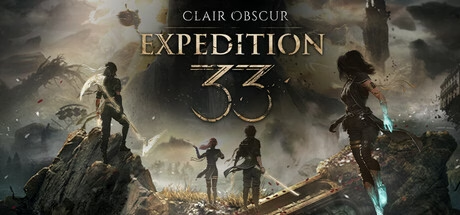
I remember the night the awards were announced, how my heart swelled with pride for what seemed like a triumph of independent spirit. Clair Obscur: Expedition 33 had captured something ethereal—a fusion of turn-based combat mechanics and visual poetry that reminded me why I fell in love with gaming in the first place. The accolades felt deserved, earned through countless hours of meticulous craftsmanship. Or so I believed.
The Unraveling of a Dream
What transpired in the days following felt like watching a beautiful tapestry come undone, thread by thread. Six One Indie, the guardians of the Indie Game Awards ceremony, made an announcement that reverberated through our community like thunder across still waters. The Game of the Year crown and the Debut Game laurel—both stripped away, revoked, dissolved into the digital ether. Not because the game lacked merit, but because of something far more complex: the shadow of artificial intelligence.
I found myself navigating a labyrinth of emotions. Sandfall Interactive, during the initial submission phase, had declared with apparent certainty that no generative AI technology had touched their creation. Yet producer François Meurisse's previous admission to a Spanish publication painted a different picture entirely. The contradiction wasn't just troubling—it was a betrayal of the trust we place in developers when we champion their work.
The Deception That Wounds Deeper
What disturbs me most isn't the experimentation itself. In 2022, when some team members dabbled with algorithmic assistance, the landscape was fundamentally different. The technology hadn't yet become the harbinger of displaced artists and writers, the specter that now haunts creative industries. Innovation often requires exploring uncharted territories, testing boundaries, discovering what tools might enhance rather than replace human artistry.
No, what cuts deeper is the concealment—the quiet replacement of questioned assets without acknowledgment, without conversation, without the transparency that independent gaming communities have built our foundations upon. When fans discovered the AI-generated elements post-launch, Sandfall responded with silence first, action second. Were those controversial assets always destined for removal, or did they vanish only when scrutiny intensified? These questions linger like morning mist, refusing to dissipate.
The formal disqualification came with clinical precision:
| Award Category | Original Winner | New Recipient |
|---|---|---|
| Game of the Year | Clair Obscur: Expedition 33 | Blue Prince |
| Debut Game | Clair Obscur: Expedition 33 | Sorry We're Closed |
Both Blue Prince and Sorry We're Closed deserve their recognition—they are magnificent creations in their own right. Yet receiving awards under these circumstances feels bittersweet, like inheriting treasure found in someone else's shipwreck.
The Community Divided
Our community stands fractured now, split along philosophical fault lines. Some defend Sandfall with passionate fervor, arguing that early experimentation shouldn't condemn an entire project, that the development journey matters less than the final product we hold in our hands. They point to the game's innovative combat systems, its breathtaking aesthetic design, its narrative depth that rewards careful exploration.
Others, myself included at times, struggle with the implications. The lying to IGA wasn't just procedural dishonesty—it was a fundamental breach of the social contract between creators and their audience. Independent gaming thrives on authenticity, on the belief that behind every pixel and polygon stands a human being pouring their vision into the digital realm. When that belief wavers, something precious begins to crumble.
Some whispers suggest jealousy motivated the renewed attention, rival studios bitter about Expedition 33's meteoric rise. Perhaps there's truth in that cynicism. Success always attracts skeptics and adversaries. Yet even accounting for potential bad faith actors, the core issue remains: generative AI content existed in a game whose developers initially denied its presence.
Reflections on Artificial Creation
I've spent countless hours contemplating what generative AI means for our medium. The technology itself exists in moral neutrality—neither inherently virtuous nor villainous. It's a tool, like any other, capable of augmenting human creativity or replacing it entirely depending on how we wield it. In skilled hands, AI assistance might sketch initial concepts that artists then refine into something transcendent. In careless applications, it becomes a shortcut that undermines the very craftsmanship that makes gaming magical.
The tragedy here isn't that Sandfall experimented during development. The tragedy is that they obscured that experimentation, denied it when asked directly, and only acknowledged it when evidence made denial impossible. Transparency could have transformed this into a meaningful conversation about creative processes in our evolving technological landscape. Instead, it became a cautionary tale about honesty and accountability.
What This Means for Us All
As I navigate through 2026, this controversy feels emblematic of larger tensions within gaming culture. We stand at a crossroads where traditional craftsmanship meets algorithmic acceleration, where indie authenticity confronts commercial pressures, where our definitions of "art" and "creation" require constant reevaluation.
Key Lessons Emerging:
-
✨ Transparency builds trust: Communities forgive mistakes far more readily than concealment
-
🎨 Process matters: How we create shapes what we create
-
🤝 Accountability strengthens communities: Owning mistakes fosters growth
-
🔮 Technology requires ethics: Tools are neutral; their application isn't
-
💎 Quality doesn't excuse dishonesty: Excellence and integrity must coexist
The Indie Game Awards' hard stance on generative AI reflects genuine concern about preserving spaces for human creativity. Whether that stance remains sustainable as technology evolves remains uncertain. But their consistency in applying stated rules, even when it meant revoking prestigious awards, demonstrates institutional integrity that our community needs.
Personal Verdict
Does Clair Obscur: Expedition 33 deserve the scrutiny it faces? The question feels simultaneously too simple and impossibly complex. The game itself—the experience I navigated through, the battles I orchestrated, the story that unfolded—remains magnificent. Those qualities haven't diminished. What's diminished is trust, that intangible currency that makes independent gaming communities function.
Sandfall created something beautiful, then tarnished it not through the AI experimentation itself, but through the subsequent dishonesty. They deserve acknowledgment for their artistic achievements while being held accountable for their procedural failures. Both truths can coexist. Both truths must coexist if we hope to navigate these technological transformations with our values intact.
I think about the developers behind Blue Prince and Sorry We're Closed, now unexpectedly thrust into spotlight positions they didn't anticipate. Their acceptance speeches, scheduled for recording in early 2026, will inevitably address this complicated context. I hope they celebrate their achievements while acknowledging the bittersweet circumstances. Their games earned recognition through transparent creation and honest representation.
Moving Forward
As someone who cherishes independent gaming's spirit—its willingness to take risks, its commitment to artistic vision over market calculation, its belief that small teams can create experiences that rival any AAA production—this moment feels like growing pains. We're collectively learning what standards we want to maintain as our creative tools evolve.
Perhaps five years from now, we'll look back at this controversy as the moment our community established clear boundaries around algorithmic assistance. Or perhaps we'll see it as misguided resistance against inevitable technological integration. Time, as always, will render its patient judgment.
What I know with certainty is this: honesty matters. Transparency matters. The stories we tell about how we create matter almost as much as what we create. Expedition 33 remains a remarkable game diminished by avoidable controversy. Its legacy will forever carry this asterisk, this reminder that excellence without integrity builds castles on unstable foundations.
I'll continue playing games created through transparent processes, supporting developers who treat their communities as partners rather than consumers to be managed. That's the future I want to help build—one where innovation and integrity aren't competing values but complementary forces driving our medium forward.
The crown has fallen, but the conversation continues. And in that continuation lies hope for clearer paths forward. 🌟
